The Invitation of Evensong
We live in an era starved of beauty. This is, perhaps, the inevitable result of a society that increasingly rejects truth and goodness; it is also the result of a tendency to make nearly everything efficient, inexpensive, and commercial. As Roger Scruton puts it, “Beauty is vanishing from our world because we live as though it did not matter.” Because we live in an era of unfettered choice - unfettered except by our ability to afford what we would choose - we too easily become simply consumers, passively using up the cultural capital passed down to us over the centuries.
This is especially true in the arts where poetry and serious literature are nearly absent from our broader culture because they require work and attention rather than the mere consumption that will suffice for a television show or the latest young adult save-the-world novel or transgressive romance. The visual arts promote individuality and shock value over transcendence (as does contemporary poetry), and music is increasingly manufactured as a consumer product rather than something with which the listener actively engages - which we cannot, most of us, because we have not learned how to play an instrument or sing well. Mr. Darcy acidly quips that "every savage can dance," but can we?
If earthly beauty is as much a reflection of God (who himself is Goodness, Truth, and Beauty) as goodness and truth are, then the absence or dismissal of beauty will have spiritual consequences. Scruton writes, "Our need for beauty is not something that we could lack and still be fulfilled as people. It is a need arising from our metaphysical condition, as free individuals, seeking our place in a shared and public world. We can wander through this world, alienated, resentful, full of suspicion and distrust. Or we can find our home here, coming to rest in harmony with others and with ourselves. The experience of beauty guides us along this second path: it tells us that we are at home in the world, that the world is already ordered in our perceptions as a place fit for the lives of beings like us.
We might substitute "persons made in the image of God" for "free individuals" and add "designed for communion with God and the ordering of creation" to "seeking our place," but his point is exactly right. Beauty brings consolation because it allows us to reflect upon the disorders of our world in light of the unchanging transcendent world; beauty is thus a spur to hope and a strong weapon against despair (and even very ordinary beauty will do: "Do you remember the Shire, Mr. Frodo? It'll be spring soon. And the orchards will be in blossom…. And they'll be sowing the summer barley in the lower fields... and eating the first of the strawberries with cream. Do you remember the taste of strawberries?”).
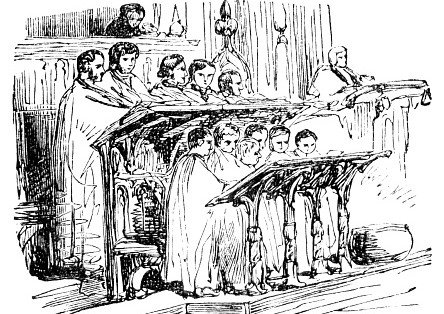
Being the very kingdom of God and the vestibule of heaven, the Church catholic has embraced beauty along with goodness and truth in her proclamation of the kingdom and in her worship of God. Choral Evensong is a particularly beautiful gem of the Church's treasure house, and one particularly developed by our own branch. Composer John Rutter writes of it, "Words and music combine to create an experience that has been described as balm for the soul, a finger pointing heavenwards, an oasis of light in a dark world… in a word, spiritual." We find consolation in the beauty of evensong because we are (through beauty itself, even if we are not attending to the truth of the words as we ought) directed past the temporal - especially ourselves - to things eternal and transcendent. We are reminded through that encounter that our struggles and problems will not have the final say, that beyond the chaos and uncertainty of this life lies the order of God's sovereign lordship, that justice and peace will triumph in the end. Or, as Scruton puts it, “Nobody who is alert to beauty, therefore, is without the concept of redemption - of a final transcendence of mortal disorder into a ‘kingdom of ends’. In an age of declining faith art bears enduring witness to the spiritual hunger and immortal longings of our species." That is, beauty has the ability to remind us of the restless longings of our hearts; C.S. Lewis, paraphrasing St. Augustine, writes, "If I find in myself desires which nothing in this world can satisfy, the only logical explanation is that I was made for another world.”
Christ teaches us, "Ye are the light of the world. A city that is set on a hill cannot be hid. Neither do men light a candle, and put it under a bushel, but on a candlestick; and it giveth light unto all that are in the house." We are the light of the world because we have been made partakers of "the true Light, which lighteth every man that cometh into the world." Evensong is one candlestick on which we are able to display the beauty of the light of Christ to a person who may be unable to see his truth or taste of his goodness; the beauty of Evensong may be a step towards a longing for truth and goodness as well.
Malcolm Guite, English poet, priest, and fellow of Girton College, Cambridge, presents Evensong in a similar vein. He reaches out to the (presumably mostly secular) university students during the intense pre-exam season.. "Take some space: unwind at the end of a hectic day. Be still for 20 minutes in the candlelight. No demands. No sermon." He observes them as they attend. ”And it seems to be helpful for quite a few of them. Of course I know that liturgy can and should be so much more than a stress-buster, but maybe… the whole experience is in some way a touching of the hem of Christ's garment: something has been given, something disclosed. And the person holding a candle at compline may hear a call, and make a journey, as another stressed woman once did, from touching the hem of Christ's garment to meeting him face to face.”
Choral Evensong is a precious treasure of our tradition that has been passed on for nearly five hundred years. Our parish, in her own small way, takes up the challenge of passing this on to the Church of the twenty-first century. She invites parishioners to partake of the beauty of the service, supported by the truth presented in its words and, through that participation, to glimpse the vision of our joys and struggles in this temporal life from a transcendent perspective. Through the offering of Evensong, she invites those on the outside "to behold the fair beauty of the Lord, and to visit his temple."